
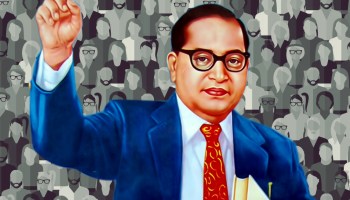
GHANSHYAM J PATEL | Dr. Bhimrao Ramji Ambedkar, the pivotal architect of the Indian Constitution, a bohemian leader and a prominent nation-builder of modern India. His contributions in field of economies, polity and social science are consider as path breaking. He was a proficient economist, an extraordinary social scientist, a sagacious parliamentarian, a genuine social reformer and a bastion of human peace and love. His holistic approach towards the development of country is also commendable. The critics of Ambedkar’s pristine ideas of nationalism and national integration has alluded us to reconsider as well as analyse these ideas of Ambedkar. These ideas had played intrinsic role in struggle with different ideologies and it was only the Ambedkar who attempted to profoundly explain a well-developed concept of nationalism and tried to apply it the Indian situation.
Ambedkar’s vision and ideas regarding nationalism
In general sense nationalism means an ideology squarely rested upon a one’s devotion towards one’s motherland or any other country of one’s choice. It is any convoluted mixture of claims, directives and attitudes for action attributing a vital moral, cultural and political value to a country and nationality. Thus, deriving distinct duties and rights from these attributed values. Ambedkar’s approach towards the Indian nationalism initiated with distinct aims and objectives, which tantamount to the advancement of marginalized section of society. He strived for equal rights of lower strata of society as they were abysmally deprived of equality and basic civil rights. He firmly believed that without development of these people a nation can’t be empowered in real sense.
Ambedkar’s sui generis idea of nationalism was developed from a remonstration against both the internal oppression and external domination. Ambedkar’s nationalism attempts to create a spirit of communal brotherhood, sense of unity and a strong resolve to improve conditions of oppressed section of the same country. He once avowed that “is entirely wrong to concentrate all our attention on the political independence of our country, and to forget the foremost serious problem of social and economic independence. It is suicidal to imagine that political independence necessarily means real all-sided freedom.”
He wanted inner unity among different sections of society and believed that social assimilation process is integral to development of nation. He basically wants to negate caste spirit i.e. is only a deeply ingrained communalism. Therefore, regardless of color, caste and creed, nationalism gets perfectly streamlined if social harmony and brotherhood ubiquitously prevail across a nation. He firmly advocates for religious tolerance and aspires that, “religion should be the force which deepens the solidarity of human society which can bring people together for social and emotional unity, can lead the people to military unity and political stability.”
According to him, nationalism in India has posited a novel doctrine, which he called “the divine right of the majority to rule the minorities according to the wishes of the majority.” He further commented that “any claim for the sharing of power by the minority is called communalism, while monopolizing the whole power by the majority is called nationalism. He condemns all forms of oppression and hypocrisy in the name of nationalism and religion.
Many people criticize Ambedkar for his logger heads with congress led freedom struggle but these naysayers fail to understand that emancipation from internal forms of oppression and slavery is equally important as freedom from external domination i.e. British rule. He once remarked that “Philosophically, it may be possible to consider a nation as a unit but sociologically, it cannot be regarded as consisting of many classes and freedom of the nation, if it is to be a reality, must vouchsafe the freedom of the different classes comprised in it, particularly of those who are treated as the servile classes. If freedom of a country cannot be distinguished from freedom of its people, true freedom would be misleading concept.”
His entire vision for nationalism stems from his spirit of self-respect both for the nation and for the people. He had ample feeling for the untouchables and the poor which motivated him to fight for their basic rights.
Ambedkar’s vision and ideas regarding national integration
National integration is the general consciousness of a common identity among the citizens of a country. It basically means that though we belong to different regions, castes, speak different languages and follow different religions, we acknowledge the fact that we are all one. Ambedkar strongly believes in a cohesive society, which he envisaged would eliminate the evils of existing traditional arrangement and further lead to social integration of backward section of society into the mainstream society.
Further it facilitated promotion of national integration and unity. His views on national integration were lucidly posited in the preamble of our constitution “we the people of India, having solemnly resolved to constitute India into a sovereign socialist, secular, democratic republic and to secure to all its citizens justice, social, economic and political liberty of thoughts and expression, belief, faith and worship, equality of status and opportunity and to promote among them all fraternity assuring dignity of the individuals and the unity and integrity of the nation.”
The blatant criticism of Ambedkar’s ideas on nationalism and his position in India’s freedom movement
The inability to situate Ambedkar’s ideas in a suitable nationalist perspective has given leeway to people like Arun Shourie to brutally attack Ambedkar’s ideology. Arun Shourie, disinvestment minister under Bajpayee government, wrote a book titled “Worshiping False Gods: Ambedkar and the Facts which have been erased” which was published in the year 1997. According to Shourie, “Ambedkar played into the hands of the British because he was motivated by selfish careerist interests, regardless of any nationalist sentiment. Ambedkar’s appointment to the Viceroy’s Council in 1942 thus allowed the colonial power to benefit from the support of some Indians while simultaneously harshly repressing the quit India movement.”
Reactions to criticism
Shourie’s allegations regarding Ambedkar’s lack of nationalist contributions drew a fervent response from many MPs, Dalits and their supporters. S.M. Gaikwad emphasizes that “Ambedkar never opposed to India gaining freedom at any time, turned down any form of independence that did not guarantee political representation to untouchables. Moreover, Ambedkar contributed to nation building, given that he favored the elimination of caste considerations, such as untouchability, which was preventing India from constituting itself as a unified and a modern nation. Moreover, Congress represented the Indian national bourgeoisie’s drive for an overall political and economic control; while people like Ambedkar representing the most underdeveloped, servile segment of the Indian nation, tried desperately to secure for themselves some foothold in the newly emerging power structure. At most, Congress was only an elitist movement whereas Ambedkar launched a politicization of the masses without which the Indian nation would never have been able to move forward.”
Conclusion
Ambedkar’s idea of nationalism deprived mainly from the dichotomy between the social and the political. It is well known that most of our famous nationalist leaders such as Bhagat Singh, Sukhdev, Chandra Shekar Azad, Mahatma Gandhi etc. and predominantly the Hindu nationalists placed ample importance on the political aspect and almost disregarding the social aspect of nationalism. His ideas of patriotism and nationalism implied political, cultural, economic, social, liberty, equality, fraternity and moral values. He strived for not only emancipation of every oppressed person of the country but also for the freedom of all subjugated people even in free nation. Ambedkar was a liberal democrat and to call him a “nationalist” or a “patriot” would not be right. In his famous book, “Pakistan or the Partition of India”, he tackled the issue of partition very rationally and dispassionately and not adopted nationalist perceptive.
His gravamen was that without the comprehensive eradication of untouchability, caste system, dogmatic practices, discrimination on basis of caste, creed, race and gender, the political system is bound to prefer those people who are indulged in these kinds of activities. It is gospel truth that he never participated in national freedom movement and rather he vehemently opposed it. But this kind of vehement attitude ultimately contributed in laying the extensive social foundation on which the modern India stands. He also encouraged the fight against separatist and linguist ideologies. He opined that various languages must not hinder the spirit of nationalism. He further cited examples of Switzerland, Canada and South Africa which have different languages. The callous attitude of British government towards creating civic liberty and social equality made him very much vocal. In my opinion Ambedkar’s contributions carries immense importance even today and unnecessary criticism should be avoided. If we start finding faults in contributions and vision of such a great person then it would tantamount to opening of Pandora’s box.
“Be Educated, Be Organised and Be Agitated”- By B.R Ambedkar.
Ghanshyam J Patel is an undergraduate student of Gujarat National Law University, Gandhinagar. He can be reached at ghanshyam22801@gmail.com
Photo Source: opindia.com
 Cup of Court
One reply on “DR. AMBEDKAR’S VISION ON NATIONALISM AND NATIONAL INTEGRATION”
Nicely articulated. Complement !
LikeLike