
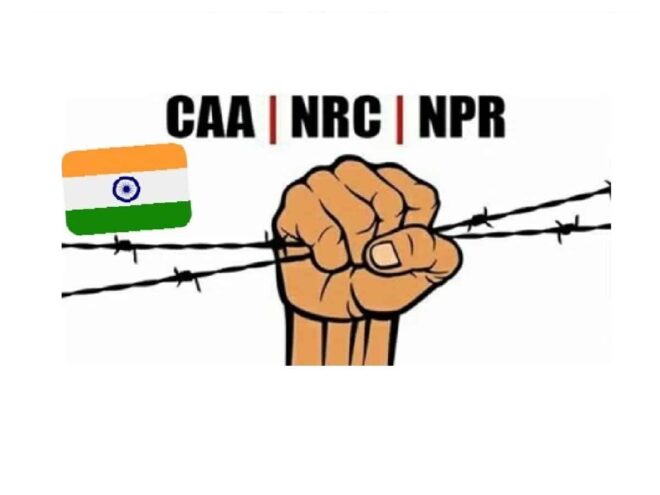
The most controversial issue at the onset of this year was enactment of the “Citizenship Amendment Act” which amended the Citizenship Act of 1955 and provided for the grant of citizenship to six religiously persecuted minorities from three adjoining nations namely Afghanistan, Pakistan and Bangladesh, people of which had arrived with a valid permit on or before 31 December 2014. These minorities consisted of Hindus, Sikhs, Jains, Buddhists, Christians and Parsis. A myriad provisions of the indenture gave rise to blazing communal as well as non-communal rifts. The main controversy was about the selection of these six minorities and the exclusion of others. There seems no valid reason for not inclusion of other minorities like the Srilankan Tamilian, the Nepali Muslims and the Ahmadias in Pakistan. These are also one of the most persecuted minorities in their respective countries.
Not only these minorities but also the people from the majority communities that are against such persecussion are also persecuted within their community. The reason told by the Government was that the bill does not take away citizenship of any one but gives the citizenship to any one deprived of their rights in their own country. If this is the reason than the Rohingyas should also be given the citizenship as they are also the vulnerable minority. But this not there. In addition to this, with the inclusion of these minorities, the Indian economy would not sustain such a huge population increase at a time. In addition to this, the government is trying to divert the public on the issue of NPR as it is not the same as during the earlier census. Various new details have included in the form. Also the government’s planning to implement the NRC in whole India is just a shit. The cost of making NRC in Assam itself costed so much that when implemented to the national level the economy and public wealth would suffer a huge back.
The most delighted controversy that would happen would be that the persons who were left out in the Assam NRC and were claiming citizenship on the basis of Indian origin would now claim it on the basis of the origin in these countries with the help of forged documents. Also the Inner Line Permit (ILP) in Assam will be of no value with the enactment of this act. Assam will be the most affected state since the the other North Eastern States have either been excluded in the act or are covered with the Sixth Schedule of the Indian Constitution. The main reason for having the ILP in Assam was to protect its cultures and traditions which will surely be destroyed with this Act. The Assamese that were in the huge majority once are already facing stiff problems from the Bengali people there and with the more Bangladeshi Migrants, mostly Bengali, there will threat to there own community and their existence. Another important aspect will be that the new citizens of India will show a bonding towards India and the Indian Constition or will be the undercover terrorist of the adjoining nation with the emphasis in Pakistan. Considering about the future aspect if this act, the similar situation may occur in the future as well then will the country again accept these refugees. If it is such than the every time the government will give citizenship to communities they like to increase their vote bank. To stop this the government should grant them either the provisional citizenship or any other method of solving this problem or hence should scrap such a idea. It is nothing the governments planning to make India a “Hindu Rashtra” which will never be succeeded as the preamble itself portrays India as Secular state.
Aayush Panwar is an undergraduate student of Gujarat National Law University, Gandhinagar. He can be reached at aayushpanwar1209@gmail.com
Photo Source: Siasat


One reply on “THE “CITIZENSHIP AMENDMENT ACT” AND ITS REPERCUSSIONS ON NPR AND NRC”
Good Efforts
LikeLike