
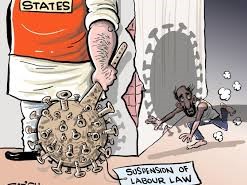
AAYUSH PANWAR | Recently various states governments have made changes in the various laws which directly affects the labour class of the country. Many stated like UP, MP and Odisha have made major changes in the enforcement of the state labour laws. The worst scenario is of the Yogi government where the government have freezed all the labour laws for the period of three years except some of the core laws. Some states have increased the working hours from 8 to 12 in a single shift so that the derailed economy could be brought back to the track. Even the weekly working hours have been increased to 72. Some states have even removed the minimum wage requirement so that it could revive the economy. The industrial dispute resolution has also been suspended in many states. But seeing it from legal perspective, it can struct down by the courts since labour is a matter of concurrent list and state cannot do against the directives of the central government which were made to comply with the guidelines of ILO.
It is the time to ponder upon the step taken by the state governments whether these steps will really help to boost the economy or will restore the condition of the labours prior to the enactment of these laws. These labour laws are still not beneficial to around 90% of the labour class in the unorganized sector. The government have thought that the reducing the minimum wages may provide an incentive to the employers to start the production. But they have forgot to think it may create an environment for exploitation. In India the labour class does not have much bargaining power and implementing such policies would worsen the situation for those daily wage earner employees who are struggling for even the basic necessity like food. The employers are already cutting the salaries of employees and no employer will be willing to hire more employees even at the decreased wage rate until the conditions improve. Increasing the duration of shift will surely decrease the demand for the labour force in the market as instead of hiring two employees for the work, the employer will simply increase the shift duration and start the production work. It will directly impact the job creation and labour welfare.
The current relief packages granted by the central government includes only the relief to the industry class that too the micro, small and medium enterprises. Nothing special relief has been provided to that class of the people without which no industry can survive. In addition to this the government is focusing more on localization and in this process we cannot forget the role of these daily wage labours. The local industry can only flourish if the labour is given its due importance and the respect it deserves.
The states also might have thought that these actions might be a bait for the companies leaving China to establish their production houses in their states. But India cannot be considered as an undemocratic substitute to China. The companies will only come when they will find the legal procedure totally fit for them. Instead of making the labour laws weak, the states should find the way to make the establishments laws somehow favourable to these companies. Changing the labour laws against the interest of the labour can never make the country achieve the goal of self-sustenance.
Aayush Panwar is an undergraduate student of Gujarat National Law University, Gandhinagar. He can be reached at aayushpanwar1209@gmail.com
Photo source: OneIndia
 Cup of Court